Operationalizable Theories of Human Learning
for Transferable Problem-Solving on Intelligent Tutoring Systems
Problem-Solving Intelligence Lab (PSI Lab / Koike Lab) is part of the Department of Electrical, Electronics and Information Engineering, Faculty of Engineering, Kanagawa University. We explore “How can the ‘compound interest’ of problem-solving—where insights gained from solving one problem prove effective on the next—be made to arise?” through interdisciplinary research that bridges Engineering (AI, Knowledge Engineering, Learning Analytics) and Science (Cognitive Science, Educational Psychology).
Focusing on “Learning”, not “Education”

Our focus is “Learning” (the learner’s experience), rather than “Education” (the teacher’s logic). No matter how well you design the teaching, the act of finally understanding a concept and acquiring a skill happens inside the learner’s head. Without knowing what is going on there, any attempt to support it with technology is just guesswork. So we aim to scientifically elucidate the process itself—how people understand new concepts, navigate trial and error, and acquire skills—and to enrich it with technology.
Learning is not just about increasing knowledge. Memorized facts often only work in the situation where they were learned, and are useless in front of a different problem. So we design “accumulative learning” where the “ways of thinking” and “ways of reflecting” gained through one problem-solving experience live on in the next—which is what turns learning into an investment that pays off, one experience helping with the one after.
Exploring the “Intersection” of Science and Engineering
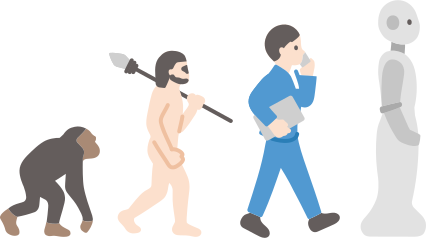
Science and engineering have taken two main approaches to learning:
- Engineering (AI / Knowledge Engineering / Learning Analytics): Build tools (systems) that actually support learning. What matters is that it works, not that it faithfully reproduces human cognition.
- Science (Cognitive Science / Educational Psychology): Uncover how people actually learn — faithfully understanding what happens in the learner’s mind.
Our research is neither pure science nor pure engineering. It is an interdisciplinary approach that integrates insights from both to create new value. Why both? Science alone can tell us “how people learn,” but it doesn’t carry that understanding all the way to a form that actually helps the learner. Engineering alone can build a supporting tool, yet it can’t explain “why the tool works,” which makes it hard to apply in a different setting. So we first understand the mechanisms of cognition, then design technology that makes learning more effective.
We don’t just build convenient apps. We model cognitive science findings from an engineering perspective, and use engineering approaches to deepen our understanding of human cognition. And rather than developing isolated tools, we aim to build foundational theories and frameworks that can be applied across many situations. Building a single app leaves you with something that ends there. Extract the underlying mechanism as a theory, though, and it can be reused on a different task or in a different field without rebuilding it from scratch.
Taking this a step further, constructing theories of learning as working systems is our methodology. When a theory is correct, the system works correctly; when it doesn’t work, we can pinpoint where the theory went wrong. Reasoning in your head alone, you can’t notice where a theory is vague or where something is missing—only by actually running it can you check whether it truly explains anything. This “understanding by building” approach is the foundation of our research.
We carry out this kind of research in the field known as “Intelligent Tutoring Systems (ITS)”.
Lab Stance
Our core values in research:
1. Formalization & Constructive Understanding
Turning “vague understanding” into “explicit explanation” (Formalization). And deepening understanding by not just theorizing, but building working systems (Constructive Understanding). If you stop at “I sort of get it,” you can’t tell whether you truly understand or only believe you do. Only when you put it in a form you can explain, and build it as something that runs, is your understanding actually put to the test. The gap between “knowing” and “doing” is always bridged by concrete output.
2. “Compound Interest” of Problem-Solving
We aim for generalizable “wisdom”—knowledge and ways of thinking that aren’t memorized for the moment but keep helping in future situations. When one piece of learning pays off on the next problem, and that in turn carries over to the one after, what you’ve learned builds up over time into a large difference—which is why we call it “compound interest.” We hold our research to the same standard: a result or a tool that helps someone in a completely different field. Only when results don’t end as one-offs does the effort put into research come back with compound interest.
3. Seeing “Information” in Failure
In learning, mistakes and failures are not things to avoid. They contain vital information about what to learn next: “What did you understand, and where did you get lost?” Hide the failure and you lose that clue along with it. The same goes for research: an unexpected result is often the doorway to a hypothesis you had overlooked. That is why we welcome people who find such results interesting and can derive the next hypothesis from them.
4. Interdisciplinary Crossing
AI, Knowledge Engineering, Learning Analytics, Cognitive Science, Educational Psychology—and anything else that’s needed. Why cross fields? Because “learning” can’t be captured with the tools of any single one: understanding it takes science, and supporting it takes engineering. So we don’t stay inside one field; we use and combine whatever tools are necessary. When members with different perspectives come together, combinations emerge that no one would think of alone. Let’s work across fields and create new ideas together.
For specific research projects, please visit the Research page.